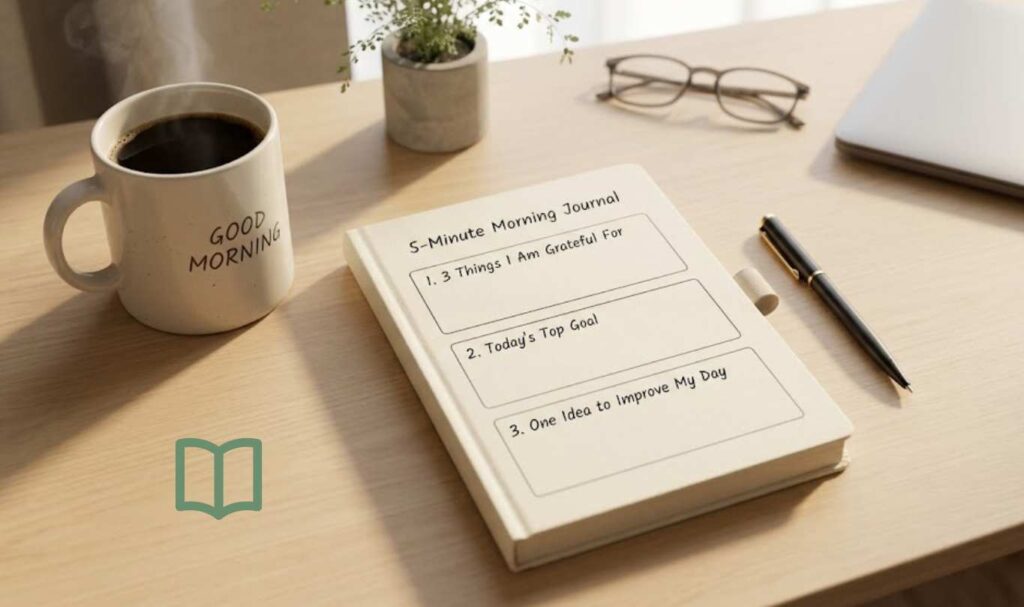
Most people who want to journal do not lack interest, they lack time. Mornings are often the worst offender: alarms, breakfast, getting out the door, and somehow the idea of “sitting down to write” feels impossible before 8am.
The good news is that journaling does not need fifteen minutes or a full page to be useful. A handful of short, structured routines can fit into five minutes and still give you the benefits: a calmer start, a clearer head, and a record of how your days actually go.
Why mornings work well for short journaling
Morning journaling has one advantage that evening journaling does not: your mind is relatively uncluttered. You have not yet absorbed the day’s messages, meetings or scrolling. A few minutes of writing before that happens can set the tone for everything that follows, without needing to process a full day’s worth of events.
The challenge is that mornings are also rushed, which is exactly why a five-minute routine works better than an open-ended one. A fixed, short format removes the decision of “what should I write about” and “how long should this take”, which are often the real reasons a morning journal gets skipped.
Five 5-minute journaling routines to try
1. The three-line check-in
Write exactly three lines: how you feel right now, one thing on your mind, and one thing you are looking forward to today. That is it. The structure does the work, so you are not staring at a blank page wondering where to start.
This routine is useful because it captures a quick emotional snapshot of your day without asking you to explain or justify anything.
2. One question, one answer
Pick a single prompt and answer it in a few sentences. Examples that work well in the morning include “What would make today feel successful?”, “What am I avoiding?” or “What do I need to let go of today?”
Keep a small list of prompts somewhere you will see it, such as the first page of your notebook or a note on your phone, so you are not trying to think of a question and answer it at the same time.
3. Gratitude plus intention
Write down one thing you are grateful for, then one thing you intend to focus on today. The gratitude line shifts your mindset before the day starts, and the intention line gives you a small anchor to return to if the day gets chaotic.
This works particularly well if your days tend to blur together, since it forces a small, specific moment of reflection each morning rather than a generic “good morning, here we go again”.
4. Brain dump and pick one
Set a timer for two minutes and write down everything on your mind, in no particular order: tasks, worries, random thoughts, things you forgot to do yesterday. Do not organise it as you go.
When the timer ends, read back over the list and circle one thing. That becomes your focus for the next few minutes, or even the day. This routine is especially useful if you tend to wake up with a lot on your mind, since it gets everything out of your head and onto paper before you try to prioritise.
5. Future-self note
Write a short note addressed to yourself at the end of the day. It might say what you hope has happened by then, what you want to remember to do, or simply “I hope today goes ok, and if it doesn’t, that’s alright too.”
This routine works well for people who find general journaling too vague, since writing “to” someone, even a future version of yourself, often makes it easier to find the right words.
Tips to make a 5-minute routine stick
A short routine is only useful if it actually happens. A few things help:
Keep your journal somewhere you will see it.** A notebook on top of your phone charger, or an app shortcut on your home screen, removes the step of “finding” your journal each morning.
Do it before anything else competes for your attention.** Journaling after you have already checked messages or social media is much harder, since your mind is already full of other people’s updates.
Use a timer if you tend to overthink.** Five minutes on a clock turns an open-ended task into a bounded one, which makes it far easier to start.
Do not aim for “good” entries.** A five-minute morning journal is a tool, not a piece of writing. Repetition, short sentences and unfinished thoughts are all fine.
Pick one routine and stick with it for a week** before switching. Trying a different format every day can make the habit feel unstable, when the goal is for it to become automatic.
What if 5 minutes still feels like too much?
If even five minutes feels hard most mornings, that is a sign to go smaller, not to give up. A single sentence, written every morning, is still a journaling habit, and it is far more useful than a five-minute entry written twice a month.
You can also move the routine to a moment that already exists in your morning, such as while the kettle boils or while you wait for an app to load. Attaching it to something that already happens removes the need to “make time” separately.
Try it tomorrow
Pick one of the five routines above and use it tomorrow morning, before you do anything else. If you are not sure which prompt to start with, the daily prompt tool on this site can give you a starting point, and the journaling style quiz can help you find a format that fits how you think.