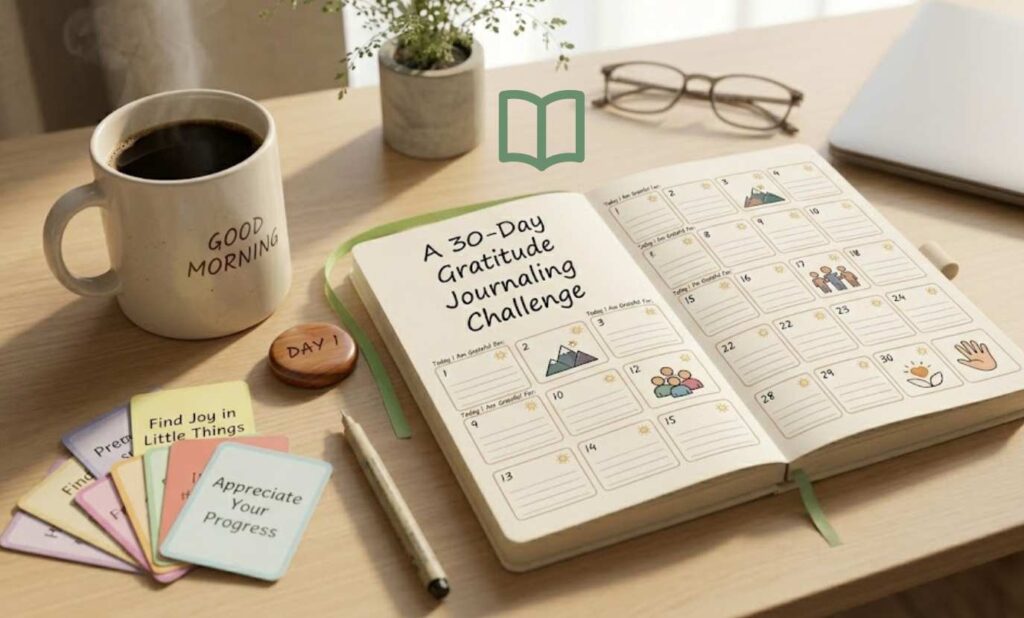
Gratitude journaling is simple in theory: write down a few things you are thankful for. In practice, many people try it for a few days, run out of new ideas, and quietly stop. A 30-day challenge fixes that by giving the habit a clear start, a clear end, and enough structure to stay interesting for the whole month.
This guide gives you a simple framework for a 30-day gratitude journal, including weekly themes so you are not stuck writing the same three things every day.
How the challenge works
The rules are deliberately simple:
- Write for 30 consecutive days. Missing a day does not mean starting over, just pick it back up the next day.
- Write between one and three things you are grateful for each day.
- Try to be specific. “My morning coffee” is more useful to write than “coffee”, because it points to a particular moment rather than a general category.
- Avoid repeating the exact same answer two days in a row. If you are tempted to write “my family” again, look for a specific moment from that day instead, such as a conversation, a small kindness, or something someone did without being asked.
You can use a notebook, a note on your phone, or this site’s daily prompt tool if you want a different angle each morning.
Weekly themes to keep it interesting
Rather than leaving each day completely open, these four weekly themes give you a different lens to look through. You do not need to follow them in order, and you can repeat a theme if it was useful.
Week 1: People
Focus on people, big or small. This could be someone close to you, but it could just as easily be a stranger who held a door, a colleague who made you laugh, or someone from years ago whose impact you still notice. Try to write about a different person each day.
Week 2: Small moments
Shift from people to moments: the first sip of a hot drink, a song that came on at the right time, five minutes of quiet before everyone else woke up. The goal of this week is to notice things that are easy to overlook because they are so ordinary.
Week 3: Things that went wrong, but taught you something
This week is slightly different. Instead of writing about something good, write about something that did not go to plan, and find one thing you are grateful for within it, even if it is small, such as “I’m grateful I noticed how I reacted, because I want to react differently next time.”
This theme often produces the most useful entries of the whole challenge, because it builds the habit of looking for something useful even on harder days.
Week 4: Yourself
The final week turns the focus inward. Write about something you did, however small, that you are glad you did. This might be sending a message you had been putting off, finishing a task, or simply getting through a difficult day. The aim is not to list achievements, but to notice effort that often goes unacknowledged, including by yourself.
Tips for sticking with it for 30 days
A few small adjustments make a real difference to whether a 30-day challenge actually gets finished:
Write at the same time each day.
Attaching it to an existing habit, such as right after breakfast or just before bed, removes the need to remember it separately.
Keep entries short.
One sentence per item is enough. The challenge is about consistency over 30 days, not the length of any single entry.
Do not aim for profound.
Some days the most honest entry will be “warm socks” or “the bus was on time”. That is fine, and often more sustainable than searching for something meaningful every day.
If you miss a day, continue from where you left off.
Do not restart the count or try to “catch up” by writing for multiple days at once, which tends to turn the habit into a chore.
Re-read your first week on day 30.
Seeing how your answers have changed, or noticing what kept coming up, is often more interesting than the daily writing itself.
What to do after day 30
By the end of the challenge, most people fall into one of two groups: those who want to keep going with daily gratitude, and those who are ready to try a different format.
If you want to continue, you do not need a new 30-day structure. Simply keep writing one to three things a day, without the weekly themes, or pick whichever week’s theme worked best for you and keep using it.
If you are ready for something different, this is also a good point to try a related technique, such as evening reflection journaling, which builds on the same noticing skill but looks at the whole day rather than isolated moments.
Start today
Pick a notebook, a note on your phone, or use the daily prompt tool on this site, and write down one thing you are grateful for from today, however small. That is day one.