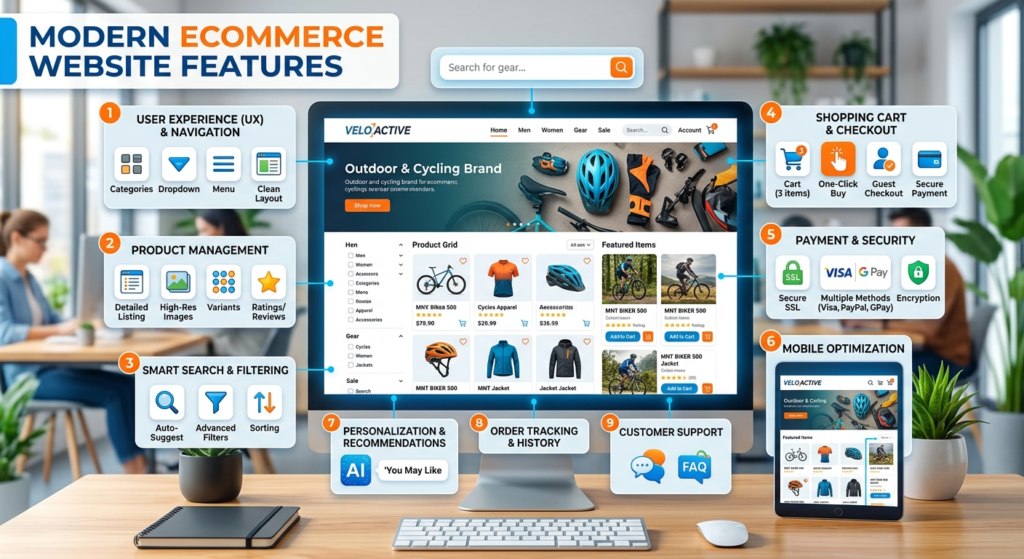
A mobile-friendly and responsive design is one of the most essential ecommerce website features for any online store. Today, a large percentage of online shoppers browse and purchase products using smartphones and tablets rather than desktop computers. If an ecommerce website does not adapt properly to different screen sizes, visitors may experience issues such as difficult navigation, unreadable text, slow loading pages, or checkout problems. These issues often lead to higher bounce rates and lost sales opportunities. A responsive website automatically adjusts its layout, images, menus, and content to provide a smooth shopping experience on every device. Beyond improving usability, responsive design also helps businesses build trust with customers because a professional-looking website demonstrates credibility and attention to user needs. Search engines also favor mobile-friendly websites, which can improve rankings and increase organic traffic. As mobile commerce continues to grow worldwide, businesses that prioritize responsive design gain a competitive advantage by making it easier for customers to browse products, compare options, add items to their carts, and complete purchases without frustration. Simply put, a responsive design is no longer an optional feature but a fundamental requirement for ecommerce success.
| Responsive Design Feature | Benefit for Online Stores |
|---|---|
| Mobile-Friendly Layout | Improves shopping experience on smartphones |
| Flexible Images | Prevents display issues on different screens |
| Touch-Friendly Navigation | Makes browsing easier for mobile users |
| Faster Mobile Performance | Reduces bounce rates |
| Consistent User Experience | Maintains brand professionalism |
| Better SEO Performance | Helps improve search engine rankings |
| Simplified Checkout Process | Increases conversion rates |
| Cross-Device Compatibility | Reaches a wider audience |
Easy Navigation and Site Structure
Easy navigation and a well-organized site structure are critical ecommerce website features that directly influence how quickly customers can find the products they want. When visitors arrive at an online store, they expect a clear path to browse categories, explore collections, and access important pages without confusion. A poorly structured website can overwhelm shoppers, causing them to leave before making a purchase. Effective navigation includes intuitive menus, logical product categories, breadcrumbs, clear call-to-action buttons, and a visible search bar. These elements work together to guide customers through the shopping journey and reduce the time required to locate specific products. An organized structure also benefits search engines by helping them understand the website’s hierarchy, making it easier to index pages and improve visibility in search results. As product catalogs grow, a strong navigation system becomes even more valuable because it prevents customers from feeling lost among hundreds or thousands of items. By creating a simple, user-friendly structure, online stores can improve engagement, increase page views, and encourage visitors to move smoothly from browsing to checkout.
| Navigation Feature | Benefit for Customers and Businesses |
|---|---|
| Clear Main Menu | Helps users find categories quickly |
| Product Categories | Organizes inventory efficiently |
| Breadcrumb Navigation | Shows users their location on the site |
| Search Bar | Speeds up product discovery |
| Dropdown Menus | Simplifies browsing large catalogs |
| Internal Links | Improves user flow and SEO |
| Sticky Navigation | Keeps important links accessible |
| Logical Site Structure | Enhances usability and search rankings |
Advanced Search and Product Filtering
Advanced search and product filtering are powerful ecommerce website features that significantly improve the shopping experience by helping customers quickly locate exactly what they need. In modern online stores, users often arrive with a specific intent, and if they cannot find the right product within a few seconds, they are likely to leave and purchase elsewhere. A strong search system includes autocomplete suggestions, typo correction, keyword matching, and intelligent result ranking to ensure users get accurate results even if their query is not perfectly written. Alongside search, product filtering allows shoppers to narrow down results based on attributes such as price range, brand, color, size, ratings, availability, and more. This combination reduces decision fatigue and helps customers compare products efficiently without scrolling through irrelevant items. For large ecommerce websites with thousands of listings, these features are not optional—they are essential for keeping users engaged and improving conversion rates. When implemented effectively, advanced search and filtering create a smoother, faster, and more personalized shopping journey that increases customer satisfaction and boosts sales performance.
| Search & Filtering Feature | Customer Benefit | Business Impact |
|---|---|---|
| Autocomplete Search | Faster product discovery | Increased engagement |
| Smart Search Results | More accurate answers | Higher conversions |
| Price Filters | Budget-friendly browsing | Better purchase decisions |
| Category Filters | Organized product selection | Reduced bounce rate |
| Brand Filters | Easy comparison | Improved user satisfaction |
| Rating Filters | Trust-based selection | Higher conversion rate |
| Availability Filter | Shows in-stock items only | Fewer abandoned searches |
| Sorting Options | Control over results order | Better shopping experience |
High-Quality Product Pages
High-quality product pages are one of the most important ecommerce website features because they directly influence whether a visitor decides to buy or leave. A product page acts as the final decision-making point where customers evaluate all necessary details before making a purchase. To be effective, it must provide clear and complete information, including high-resolution images, detailed descriptions, specifications, pricing, availability, and shipping details. Customers rely heavily on visuals and content quality to understand the product, especially in online shopping where they cannot physically inspect items. Well-structured product pages also include zoomable images, videos, size guides, and FAQs to reduce uncertainty and build trust. Another key element is persuasive yet honest product descriptions that highlight benefits while setting realistic expectations. Poorly designed product pages often lead to confusion, hesitation, and abandoned carts, while optimized pages increase confidence and boost conversions. Additionally, including customer reviews and ratings enhances credibility and helps new buyers make informed decisions based on real experiences. Overall, strong product pages bridge the gap between browsing and purchasing, making them a critical part of any successful ecommerce platform.
| Product Page Feature | Purpose | Impact on Sales |
|---|---|---|
| High-Resolution Images | Visual product clarity | Increases trust |
| Detailed Descriptions | Explain product value | Reduces confusion |
| Pricing Information | Clear cost visibility | Supports decision-making |
| Stock Availability | Real-time status | Prevents frustration |
| Customer Reviews | Social proof | Boosts conversions |
| Product Videos | Demonstration support | Improves engagement |
| Size Guides | Accurate selection | Reduces returns |
| FAQs Section | Answer common questions | Improves user confidence |
Secure Checkout and Payment Options
Secure checkout and flexible payment options are essential ecommerce website features that directly impact whether a customer completes a purchase or abandons their cart. The checkout stage is the most sensitive part of the online shopping journey because it involves personal information, payment details, and final confirmation. If the process feels complicated, slow, or unsafe, customers are very likely to leave without completing the transaction. A well-designed checkout system should be simple, fast, and transparent, reducing the number of steps required to complete a purchase. Security is equally important, as users need assurance that their financial data is protected through encryption and secure payment gateways. Offering multiple payment methods such as credit cards, debit cards, digital wallets, bank transfers, and cash on delivery further improves convenience and builds trust. Additionally, features like guest checkout, auto-filled forms, and clear cost breakdowns help reduce friction and improve user satisfaction. A smooth and secure checkout experience not only increases conversions but also strengthens customer confidence in the brand, encouraging repeat purchases in the future.
| Checkout Feature | Customer Benefit | Business Advantage |
|---|---|---|
| SSL Encryption | Protects sensitive data | Builds trust |
| Guest Checkout | Faster purchase process | Reduces abandonment |
| Multiple Payment Options | Flexibility for users | Higher conversion rates |
| Auto-Fill Forms | Saves time | Improves usability |
| Transparent Pricing | No hidden charges | Increases trust |
| One-Page Checkout | Simple experience | Faster completion |
| Digital Wallet Support | Quick payments | Higher mobile sales |
| Order Summary Display | Clear purchase review | Fewer errors |
Customer Reviews and Social Proof
Customer reviews and social proof are powerful ecommerce website features that help build trust and influence buying decisions. In online shopping, customers cannot physically examine products, so they rely heavily on the experiences and opinions of other buyers. Reviews, ratings, testimonials, and user-generated content provide authentic feedback that helps new visitors feel more confident about their purchases. A product with positive reviews is more likely to convert compared to one with no feedback, even if both products are similar in quality and price. Social proof also includes elements like star ratings, number of purchases, influencer endorsements, and real customer photos, all of which contribute to a stronger sense of credibility. When implemented correctly, reviews not only improve trust but also provide valuable insights for businesses to improve their products and services. However, it is important for ecommerce platforms to maintain transparency by displaying genuine reviews and allowing users to share both positive and negative experiences. This honesty enhances long-term brand reputation and encourages repeat customers.
| Social Proof Feature | Purpose | Impact |
|---|---|---|
| Star Ratings | Quick quality assessment | Influences purchase decisions |
| Written Reviews | Detailed user feedback | Builds trust |
| Customer Photos | Real product usage | Increases authenticity |
| Verified Purchase Tags | Confirms real buyers | Improves credibility |
| Testimonials | Brand trust building | Strengthens reputation |
| Review Sorting | Helps find useful feedback | Enhances usability |
| Q&A Section | Answers user doubts | Reduces hesitation |
| Social Media Mentions | External validation | Expands brand reach |
Fast Loading Speed and Performance
Fast loading speed and strong website performance are critical ecommerce website features that directly affect user experience, search engine rankings, and conversion rates. In today’s digital environment, customers expect websites to load within a few seconds, and even a slight delay can lead to frustration and increased bounce rates. A slow ecommerce website not only loses potential customers but also damages brand reputation because users often associate speed with professionalism and reliability. Performance optimization includes techniques such as image compression, efficient coding, caching, and the use of content delivery networks to ensure that pages load quickly across different regions and devices. Fast websites allow users to browse products smoothly, move between pages without interruptions, and complete checkout processes without delays. Additionally, search engines prioritize fast-loading websites because they provide a better user experience, which can significantly improve organic visibility. As competition in online retail continues to grow, maintaining high performance is no longer optional but a necessity for attracting and retaining customers. A fast website ensures that visitors stay engaged, explore more products, and are more likely to complete purchases.
| Performance Feature | Function | Business Benefit |
|---|---|---|
| Image Optimization | Reduces file size | Faster page loading |
| Browser Caching | Stores data locally | Improved repeat visits |
| Content Delivery Network | Speeds global access | Better international reach |
| Clean Code Structure | Improves efficiency | Smooth website performance |
| Lazy Loading | Loads content on demand | Faster initial display |
| Server Optimization | Enhances response time | Higher reliability |
| Minified Files | Reduces load time | Better speed scores |
| Performance Monitoring | Tracks issues | Continuous improvement |
SEO and Marketing Features
SEO and marketing features are essential ecommerce website features that help online stores attract visitors, increase visibility, and drive consistent traffic from search engines and digital channels. Without strong SEO implementation, even the best-designed ecommerce website may struggle to reach potential customers. These features include optimized URLs, meta titles and descriptions, structured data, keyword-rich content, and clean site architecture that allows search engines to crawl and index pages effectively. Marketing tools such as email campaigns, discount banners, abandoned cart reminders, and social media integration also play a major role in converting visitors into paying customers. A well-optimized ecommerce platform ensures that product pages rank higher in search results, making it easier for users to discover products organically. Additionally, analytics and tracking tools help businesses understand customer behavior, measure performance, and improve marketing strategies over time. When SEO and marketing features work together, they create a powerful system that not only brings traffic but also converts that traffic into long-term customers.
| SEO & Marketing Feature | Purpose | Benefit |
|---|---|---|
| Meta Tags Optimization | Improve search visibility | Higher rankings |
| SEO-Friendly URLs | Clean website structure | Better indexing |
| Email Marketing Tools | Customer engagement | Repeat sales |
| Abandoned Cart Emails | Recover lost sales | Increased revenue |
| Social Media Integration | Wider reach | Brand awareness |
| Discount & Coupon System | Encourage purchases | Higher conversions |
| Analytics Tracking | Monitor performance | Data-driven decisions |
| Structured Data | Rich search results | Better click-through rates |
Conclusion
In conclusion, understanding and implementing the right ecommerce website features is essential for building a successful online store that attracts visitors, keeps them engaged, and converts them into loyal customers. From mobile-friendly design and smooth navigation to secure checkout systems and strong SEO capabilities, every feature plays a direct role in shaping the overall shopping experience. Businesses that invest in performance, usability, trust-building elements, and marketing tools are far more likely to stand out in a highly competitive digital marketplace. A well-structured ecommerce website not only improves customer satisfaction but also increases sales, strengthens brand credibility, and supports long-term growth. As customer expectations continue to evolve, regularly updating and optimizing these features ensures that an online store remains efficient, modern, and competitive.
FAQs
What are the most important ecommerce website features?
The most important features include mobile responsiveness, secure checkout, fast loading speed, product pages, and easy navigation.
Why is mobile-friendly design important for ecommerce websites?
Because most users shop on mobile devices, responsive design ensures smooth browsing and increases conversion rates.
How do ecommerce features improve sales?
They improve user experience, build trust, reduce friction in checkout, and help customers find products easily.
What role does SEO play in ecommerce websites?
SEO helps improve search engine rankings, bringing more organic traffic and increasing visibility for products.
For More Updates Visit: journalingtechniques