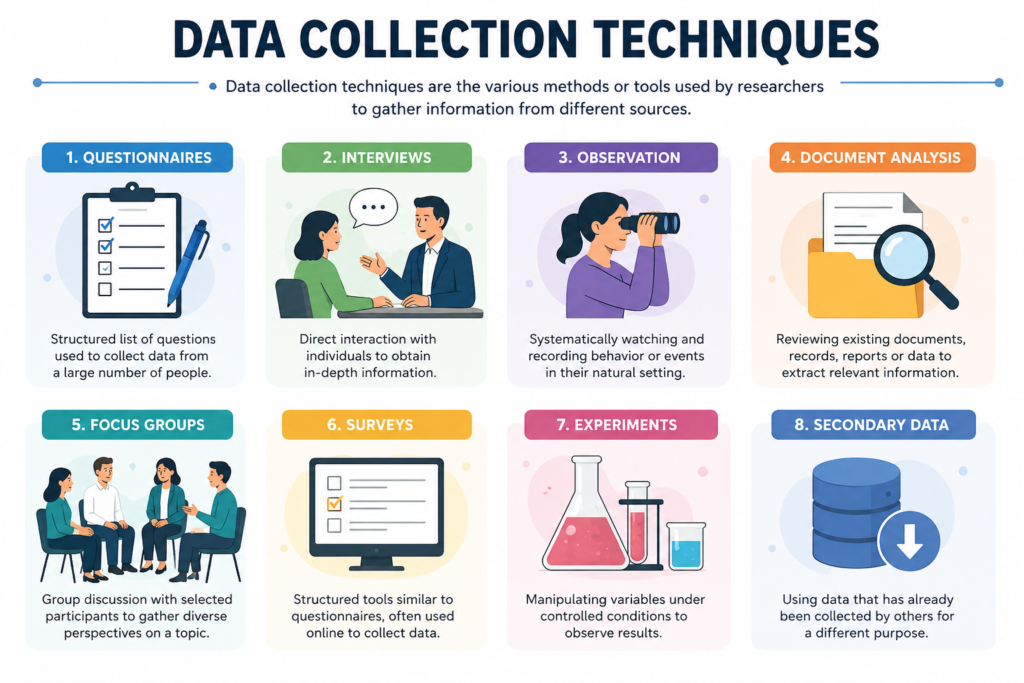
Data collection plays a foundational role in modern research because it determines how accurate, reliable, and meaningful the final results will be. In almost every field—whether it is business, healthcare, education, or social sciences—researchers depend on data collection techniques to gather evidence that supports their findings. Without proper data, decisions become guesswork rather than evidence-based conclusions. For example, governments rely on population and economic data to design policies, while companies use customer data to improve products and services. This shows that data collection is not just a technical step but a critical part of decision-making and problem-solving.
In today’s digital world, the importance of data collection techniques has increased even more due to the rise of big data and advanced analytics. Organizations now collect massive amounts of structured and unstructured data from various sources such as surveys, online platforms, sensors, and user interactions. This information helps identify patterns, predict trends, and improve efficiency. As a result, effective data collection is considered the backbone of successful research, ensuring that insights are based on real and verifiable information rather than assumptions.
Survey Methods in Data Collection
Surveys are one of the most widely used data collection techniques because they allow researchers to gather information from a large group of people in a structured and efficient way. A survey typically includes a set of questions designed to collect specific types of data, such as opinions, behaviors, preferences, or demographics. These questions can be distributed through online forms, paper questionnaires, phone interviews, or face-to-face interactions. The main advantage of surveys is that they make it possible to collect standardized data from many respondents quickly, which is especially useful in fields like market research, education, and public policy.
Another important aspect of survey-based data collection techniques is their flexibility in design. Researchers can use closed-ended questions for statistical analysis or open-ended questions to gather more detailed insights. However, the quality of survey results depends heavily on how well the questions are designed and how representative the sample group is. Poorly structured surveys can lead to biased or inaccurate results, which can affect the overall reliability of the research. When designed properly, surveys remain one of the most powerful tools for understanding large populations and identifying trends in a cost-effective manner.

Interviews as a Qualitative Technique
Interviews are a highly valuable part of data collection techniques, especially when researchers need in-depth and detailed information. Unlike surveys, interviews involve direct interaction between the interviewer and the participant, allowing for a deeper exploration of thoughts, experiences, and opinions. They can be structured, where a fixed set of questions is followed, or unstructured, where the conversation flows more naturally. This flexibility makes interviews particularly useful in fields like sociology, psychology, and journalism, where understanding human behavior and motivation is essential.
One of the strongest advantages of interviews as a data collection technique is the ability to clarify responses in real time. Researchers can ask follow-up questions, probe deeper into answers, and observe non-verbal cues such as tone, expressions, and body language. This helps in gathering richer and more meaningful data compared to many other methods. However, interviews can be time-consuming and may introduce interviewer bias if not conducted carefully. Despite these limitations, they remain one of the most effective ways to gain detailed qualitative insights that cannot be captured through structured methods alone.
Observation Methods for Real-World Insights
Observation is one of the most practical data collection techniques because it focuses on gathering information by directly watching people, events, or behaviors in their natural setting. Instead of asking questions or relying on self-reported data, researchers record what they actually see. This method is widely used in fields such as psychology, anthropology, education, and market research, where real behavior often provides more accurate insights than written or spoken responses. Observation can be structured, where specific behaviors are recorded systematically, or unstructured, where researchers simply note general patterns and interactions.
A key strength of observation as a data collection technique is its ability to capture authentic behavior without external influence. People often behave differently when they know they are being questioned, but observation helps reduce this bias by studying actions in real time. However, it also has limitations, such as the possibility of subjective interpretation and the time required to gather meaningful data. Despite these challenges, observation remains a powerful method for understanding how individuals or groups behave in real-world environments, making it an essential part of comprehensive research.
Experimental Data Collection Approaches
Experimental methods are among the most controlled and scientific data collection techniques, used primarily to establish cause-and-effect relationships. In this approach, researchers deliberately change one or more variables while keeping others constant to observe the outcome. This method is widely used in fields like medicine, psychology, and natural sciences, where precise and measurable results are essential. By controlling conditions, experiments help researchers determine whether a specific factor directly influences a particular result, making the findings highly reliable and valid.
A major advantage of experimental data collection techniques is the ability to produce clear, repeatable results under controlled conditions. For example, in medical research, clinical trials are conducted to test the effectiveness of new drugs before they are approved for public use. However, experiments can sometimes be expensive, time-consuming, and limited in representing real-world situations. Despite these limitations, experimental methods remain one of the strongest approaches for producing scientific evidence and supporting well-founded conclusions in research.
Secondary Data Sources and Their Uses
Secondary data collection is one of the most efficient data collection techniques, as it relies on information that has already been gathered by other researchers, organizations, or institutions. Instead of collecting new data from scratch, researchers use existing sources such as government reports, academic studies, online databases, company records, and published articles. This method is especially useful when time, budget, or resources are limited, as it allows quick access to a large amount of information without conducting fieldwork.
One of the key benefits of secondary data collection techniques is the ability to compare and analyze data from multiple sources, which can help identify trends and patterns over time. For example, economists often use government statistics to study inflation rates or employment trends, while businesses analyze industry reports to understand market behavior. However, a major limitation is that the data may not always perfectly match the current research objectives or may be outdated. Despite this, secondary data remains a valuable and widely used method because it provides a strong foundation for analysis and helps support or validate primary research findings.
Challenges in Data Collection
Despite the wide range of data collection techniques available, researchers often face several challenges that can affect the accuracy and reliability of their results. One of the most common issues is data bias, where collected information does not accurately represent the target population. This can happen due to poor sampling methods, poorly designed questions, or even participant misunderstanding. Another challenge is data inconsistency, especially when information is gathered from multiple sources that use different formats or standards, making it difficult to compare and analyze effectively.
Another major difficulty in data collection techniques is time and resource constraints. Collecting high-quality data often requires significant effort, planning, and financial investment, particularly in large-scale studies or field research. In addition, ethical concerns such as privacy and consent have become increasingly important in modern research, especially when handling personal or sensitive information. Researchers must ensure that data is collected responsibly and securely. These challenges highlight the importance of careful planning and proper execution to ensure that data collection remains accurate, ethical, and useful for decision-making.
Best Practices for Reliable Data Collection
To ensure accuracy and consistency, following best practices in data collection techniques is essential for any researcher or organization. One of the most important practices is clearly defining the research objective before collecting any data. When goals are well-defined, it becomes easier to choose the right method—whether surveys, interviews, observation, or secondary sources. Another key practice is selecting a representative sample, as this helps ensure that the collected data reflects the entire population and reduces the risk of bias.
Another crucial aspect of effective data collection techniques is maintaining data quality through proper design, testing, and validation of tools such as questionnaires or observation checklists. Researchers should also ensure ethical standards by protecting participant privacy and obtaining informed consent when required. Additionally, organizing and storing data systematically helps prevent errors and makes analysis more efficient. By following these best practices, researchers can significantly improve the reliability, accuracy, and usefulness of their collected data.
Conclusion
In conclusion, data collection techniques form the backbone of effective research and decision-making across all fields. From surveys and interviews to observation, experiments, and secondary data sources, each method offers unique advantages depending on the research goal. While challenges such as bias, resource limitations, and data inconsistency can affect results, applying the right methods and best practices ensures that the collected data remains accurate, reliable, and meaningful. As the world becomes increasingly data-driven, mastering these techniques is essential for producing insights that truly support informed decisions.
FAQs
What are data collection techniques?
They are methods used to gather information from different sources for research, analysis, and decision-making.
Which are the main types of data collection techniques?
The main types include surveys, interviews, observation, experiments, and secondary data collection.
Why are data collection techniques important?
They ensure that research is based on accurate and reliable information rather than assumptions.
What is the difference between primary and secondary data collection?
Primary data is collected directly from original sources, while secondary data is taken from existing reports or studies.
For More Updates Visit: journalingtechniques