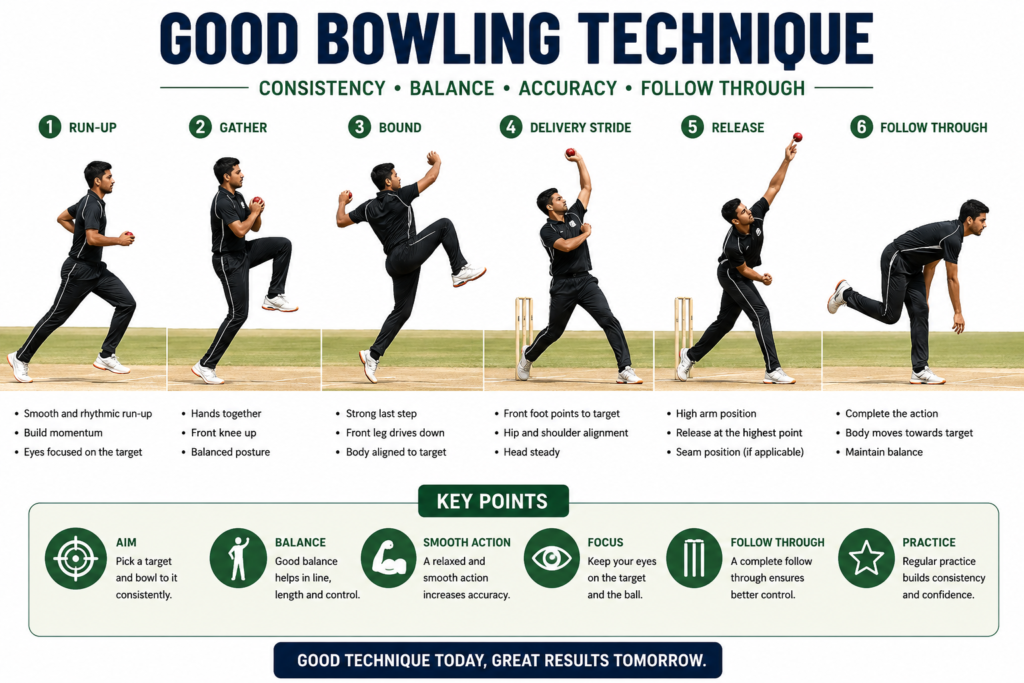
A good bowling technique always starts with strong fundamentals, because the run-up, grip, and stance decide how well a bowler can control the ball throughout the entire delivery. The run-up should be smooth, balanced, and repeatable so the bowler arrives at the crease in a stable position without losing rhythm or energy. A rushed or uneven run-up often leads to poor alignment and inconsistent deliveries, which immediately affects accuracy and control.
The grip is equally important because it determines how the ball behaves after release. Fast bowlers usually hold the seam upright to encourage movement through the air or off the pitch, while spinners use finger or wrist positioning to generate rotation. The stance at the crease also plays a major role in setting up the delivery, as a stable body position allows the bowler to transfer energy efficiently into the ball. When these three elements work together, they create the foundation of a good bowling technique, making every delivery more controlled, consistent, and effective.
Mastering Line and Length Control
Line and length control is one of the most important parts of a good bowling technique, because even a fast or spinning delivery loses its impact if it is not directed accurately. The “line” refers to the direction of the ball, such as targeting off stump, middle stump, or just outside off stump, while “length” refers to where the ball pitches on the pitch. A bowler who consistently hits the right areas can create pressure on the batter, forcing mistakes and increasing wicket-taking chances.
Developing this control requires repetition and awareness during practice sessions. Bowlers often focus on a “good length” area where the batter is uncertain whether to play forward or back, which increases the chance of an edge or miss. Maintaining discipline is key, as even a small loss of accuracy can turn a dangerous ball into an easy scoring opportunity. Mastering line and length is what separates average bowlers from skilled performers who rely on precision rather than luck.
Body Alignment and Balance in Bowling
Body alignment and balance are essential elements of a good bowling technique, because they directly affect how accurately and safely a bowler delivers the ball. When the head, shoulders, hips, and front foot are properly aligned toward the target, the bowler can transfer energy in a straight and controlled path. If the body leans too far sideways or the head moves off balance, it often results in poor direction, reduced speed, and inconsistent bounce.
Balance during the delivery stride is equally important because it helps the bowler maintain control at the point of release. A stable landing foot and a steady head position allow smoother arm action and better follow-through. Coaches often emphasize keeping the head still and eyes fixed on the target, as even slight movement can disturb accuracy. Strong alignment and balance not only improve performance but also reduce injury risk, making them a core part of any good bowling technique.
Fast Bowling Technique: Power and Accuracy
Fast bowling relies heavily on a good bowling technique that combines speed with control, rather than just trying to bowl as fast as possible. The key to effective fast bowling lies in generating momentum through a smooth run-up and transferring that energy through a strong front-foot landing and explosive arm action. However, raw pace alone is not enough; without accuracy in line and length, even the fastest deliveries can become easy scoring opportunities for batters.

To maintain both power and precision, fast bowlers must focus on rhythm and repeatability in their action. The run-up should build natural speed without forcing it, while the delivery stride should be stable enough to support a high-arm release. Many successful fast bowlers also use variations like slower balls and cutters, but these only become effective when the basic technique is solid. In essence, fast bowling is about controlling aggression—turning physical power into consistent, targeted deliveries that keep pressure on the batter throughout the spell.
Spin Bowling Technique: Control and Variation
Spin bowling depends on a good bowling technique that focuses more on control, accuracy, and subtle variations rather than raw pace. Unlike fast bowlers, spinners rely on finger or wrist action to generate rotation on the ball, which creates drift, dip, and turn after pitching. A stable body position at the crease, combined with a smooth but controlled delivery stride, allows the spinner to maintain balance while applying maximum revolutions on the ball.
Variation is the real strength of spin bowling, but it only becomes effective when the basic technique is strong. A skilled spinner can change flight, pace, and angle while still maintaining a consistent action, making it difficult for batters to predict the delivery. Control over line and length is especially important, as even a small error can give the batter scoring opportunities. When executed properly, spin bowling becomes a strategic weapon that builds pressure over time and forces mistakes through patience and precision.
Common Mistakes That Affect Bowling Performance
Even with a strong good bowling technique, many bowlers struggle because of small but critical mistakes that disrupt their rhythm and accuracy. One of the most common issues is an inconsistent run-up, where the bowler changes pace or steps before reaching the crease. This often leads to poor balance at the point of delivery and reduces both control and confidence in the action.
Another frequent mistake is losing body alignment during the delivery stride, especially when the head moves sideways or the front shoulder opens too early. This breaks the natural flow of energy and causes the ball to drift off target. Bowlers also tend to over-focus on speed or spin at the expense of accuracy, which results in loose deliveries that are easier for batters to score from. Correcting these mistakes requires disciplined practice and awareness, as even small adjustments can significantly improve overall performance and strengthen a good bowling technique.
Training Drills to Improve Bowling Skills
Improving a good bowling technique requires consistent practice through structured training drills that focus on accuracy, rhythm, and body control. One of the most effective drills is target bowling, where bowlers aim at specific spots on the pitch such as a good length area or just outside off stump. This helps develop precision and builds the habit of repeating the same delivery under different conditions.
Another useful method is shadow bowling, where the bowler practices their full action without releasing the ball. This drill improves balance, alignment, and muscle memory, allowing the body to naturally repeat the correct movements during real play. Coaches also recommend using cone or marker drills to improve line control and fitness-based bowling sets to maintain consistency under fatigue. Over time, these training methods help transform basic skills into a reliable and good bowling technique that performs well in match situations.
Conclusion
A strong good bowling technique is built through discipline, repetition, and attention to detail in every part of the action. From the run-up and grip to body alignment, line and length control, and follow-through, each element works together to create consistency and effectiveness. Bowlers who focus on fundamentals rather than just pace or spin are more likely to perform well under pressure and maintain long-term success in the game. With regular practice and correction of small mistakes, any bowler can gradually improve their skill level and become more reliable on the field.
FAQs
What is a good bowling technique in cricket?
A good bowling technique is a balanced and consistent action that allows a bowler to deliver accurate balls with proper control of line, length, and body alignment.
Why is line and length important in bowling?
Line and length are important because they determine where the ball travels and pitches, helping bowlers create pressure and force mistakes from batters.
How can I improve my bowling accuracy?
You can improve accuracy by practicing target bowling, maintaining a steady run-up, and focusing on consistent body alignment during delivery.
Is pace more important than technique in bowling?
No, technique is more important because even fast deliveries are ineffective without control, consistency, and proper execution.
For More Updates Visit: journalingtechniques